

Our Place in the Universe
After eight years of petitioning by astronomer Carl Sagan, Voyager 1 finally had approval to turn its camera toward Earth. And so on February 14, 1990, with its planetary mission complete and the spacecraft heading toward interstellar space, mission control instructed it to photograph our home one last time. The result was a remarkable image: Earth reduced to less than a single pale pixel.
Sagan later described it as “a mote of dust suspended in a sunbeam” (Pale Blue Dot: A Vision of the Human Future in Space). The “sunbeam” was actually an artifact of sunlight scattering inside the camera’s optics. Yet the image invites contrasting interpretations. Some might see in it a suggestion of providential care—a shaft of light over a world uniquely abundant with life. Sagan saw something very different: a challenge to human pride and any belief that we occupy a privileged place in the universe.
“Our posturings, our imagined self-importance, the delusion that we have some privileged position in the Universe, are challenged by this point of pale light,” he wrote. “Our planet is a lonely speck in the great enveloping cosmic dark. In our obscurity, in all this vastness, there is no hint that help will come from elsewhere to save us from ourselves.”
“If human life is a passing episode, hardly noticeable in the vastness of cosmic processes; if there is no superhuman purpose, and no hope of ultimate salvation, it is better to know. . . .”
Sagan sought to answer the bleakness of that conclusion with an ethical appeal. If no help will come from elsewhere, he argued, then humanity must accept responsibility for itself: “To me, it underscores our responsibility to deal more kindly with one another and to preserve, and cherish, the pale blue dot, the only home we’ve ever known.” It’s a laudable and essential goal. But more than three decades later, how well have we met it? Are we any closer to saving ourselves—or the planet?
An Indifferent Universe?
Sagan had expressed his view in his 1980 book Cosmos, describing Earth as an “insignificant planet of a humdrum star . . . tucked away in some forgotten corner of a universe.” The universe, he wrote, “seems neither benign nor hostile, merely indifferent to the concerns of such puny creatures as we.”
That idea was not new. Earlier in the 20th century, philosopher Bertrand Russell had portrayed the universe as indifferent to human life and desire—without purpose and without hope of salvation. Nor was Russell the first or last to reach such a conclusion. The concern runs through materialist and existentialist thought, from certain ancient Greek thinkers to Camus, Sartre, Beckett and their intellectual heirs.
“As if that blind rage had washed me clean, rid me of hope; for the first time, in that night alive with signs and stars, . . . I opened myself to the gentle indifference of the world.”
Earthrise: A Different Response
A contrasting, and quite striking, famous image of Earth from space had preceded the pale blue dot. In December 1968, Apollo 8 returned a color photograph of Earth rising above the lunar surface. Often described as one of the most influential environmental photographs ever taken, Earthrise helped galvanize the global environmental movement of the late 20th century.
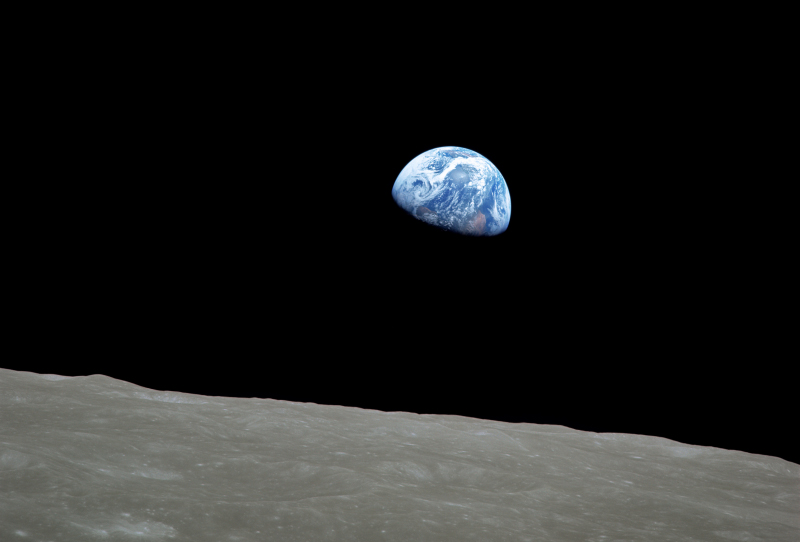
The astronauts later recalled that the most important discovery of their lunar journey was Earth itself—“a grand oasis in the big vastness of space,” as Jim Lovell described it during the live broadcast from the mission. Before the flight, they had searched for words appropriate to broadcast from the moon during December—a season associated with light and goodwill. Unlike Sagan, they chose to frame Earth’s existence in a biblical rather than an agnostic context. They read the first 10 verses of Genesis, a passage about God, origins and Creation.
Compared to Sagan’s more pessimistic framing, this was a profoundly different response to the sight of Earth from afar.
“Awe engages five processes—shifts in neurophysiology, a diminished focus on the self, increased prosocial relationality, greater social integration, and a heightened sense of meaning—that benefit well-being.”
A biblical author likewise reflected on humanity’s place in the universe, but he looked up at the heavens from Earth rather than back at Earth from space. His thoughts went not to loneliness, obscurity and meaninglessness. He asked: “When I look at your heavens, the work of your fingers, the moon and the stars that you have established; what are humans that you are mindful of them, mortals that you care for them?” (Psalm 8:3–4, New Revised Standard Version).
The psalmist David concluded that, despite the frailty of human beings when measured against the vastness of space, the Creator had nevertheless “made them a little lower than God, and crowned them with glory and honor” (verse 5).
Here cosmic scale does not erase human significance. Earth is not merely a lonely speck whose inhabitants must save themselves. It is a unique home for humanity within a purposeful creation—a place where salvation ultimately comes from beyond ourselves.